Prince of Persia1989
Prince of Persia 1989: the DOS Version, All Ports and How They Differ
Jordan Mechner's 1989 platformer started on the Apple II and then travelled to nearly every computer and console of its day. The DOS version and the ports differ in more than graphics.
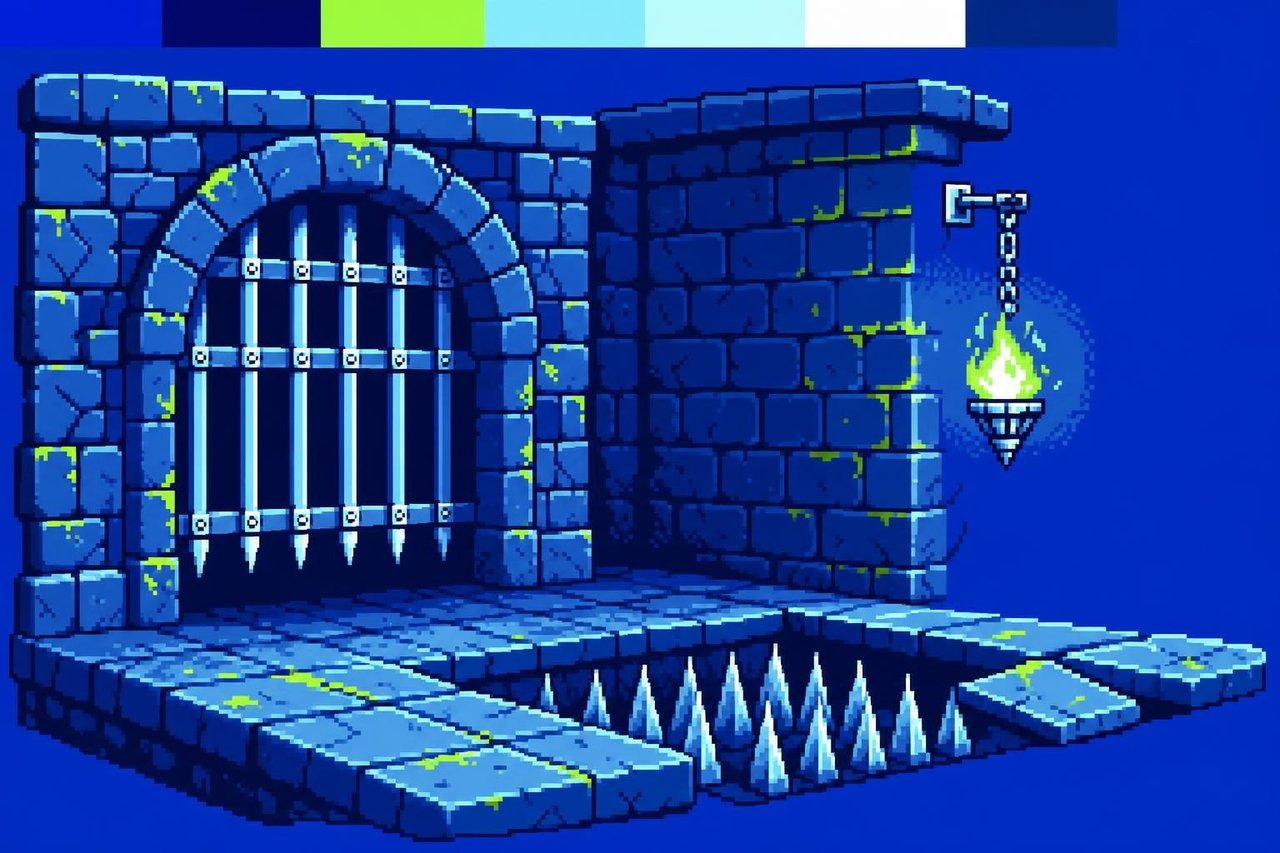
What Prince of Persia 1989 is
Prince of Persia is a cinematic platformer in which a young man, thrown into a dungeon, has an hour to rescue a princess from the Grand Vizier Jaffar. The prince runs, climbs, hangs from ledges and jumps across gaps, and the levels are full of loose floor tiles, spikes, slicing blades and gates opened by pressure plates. Sword duels happen against one guard at a time, and a bad fall or a trap can end a life at once.
Jordan Mechner designed and programmed the game, and Broderbund published it. The prince’s fluid, realistic movement set it apart from other games of 1989, and the animation is still the first thing most people notice when they pick the game up today.
The campaign has twelve levels and a sixty-minute clock. The clock is the real opponent: a player who explores every room will not finish.
The Apple II original
The first release was for the Apple II, in North America on 3 October 1989. Mechner wrote it for that machine. Japan and Europe received the game in the middle of 1990. In April 2012 Mechner released the Apple II source code on GitHub, along with a technical document describing it.
The Prince of Persia 1989 DOS version
The Prince of Persia 1989 DOS release is the reference most fan tools target, and a Prince of Persia 1989 DOS build is what the open-source reimplementations expect as their source of data files.
The prince of persia 1989 dos release appeared in April 1990. It was made alongside the Apple II game and drew on it directly, and Wikipedia describes it as having better graphics and sound than the Apple II original. For a large part of the audience this is the game.
The DOS game keeps its graphics, sounds, music and level layouts in a small set of resource files, among them PRINCE.DAT and KID.DAT. Their structure is documented by fan researchers, and the page on Prince of Persia DAT files describes what each container holds and how the common tools read them.
Ports and platforms
The prince of persia 1989 ports are numerous, and they were handled by different companies. Broderbund produced a few itself, and outside studios made most of the rest. The list below follows the credits and dates in the Wikipedia entry for the game, where several dates are not given.
- Mac: converted by Presage Software for classic Mac OS.
- Amiga: Dan Gorlin for Domark, released in Europe in December 1990.
- Atari ST: Broderbund, March 1991.
- PC-98 and X68000: Japanese computer versions, the PC-98 one by Arsys Software for Riverhillsoft in July 1990, with a redesigned prince in turban and vest.
- FM Towns: Riverhillsoft, with a CD audio soundtrack.
- Amstrad CPC and SAM Coupé: smaller European conversions, the latter by Chris White for Revelation.
- Master System and Game Gear: both by The Kremlin for Domark, the Master System one on 1 October 1992.
- Sega CD: Bits Laboratory, April 1993 in Europe.
- Super NES: Arsys Software, with Konami publishing it in the United States and Europe.
- NES: MotiveTime for Virgin Games in the United States and Mindscape in Europe, with music by Mark Cooksey.
- Mega Drive and Genesis: Domark, with Tengen as the US publisher, February 1994 in North America.
- Game Boy Color: Ed Magnin and Associates for Red Orb Entertainment.
How the ports differ
The versions are not interchangeable. The Super NES release is the best-known departure: it doubled the time limit to 120 minutes and added levels that did not exist in the computer game, with new enemies, traps and music. Sources disagree on how many levels were added, with the article giving both eight and ten in different places, so the exact figure should be checked against the game itself. The FM Towns version is notable for streaming a CD soundtrack, and the Japanese PC-98 version changed the prince’s appearance.
Anyone comparing the prince of persia 1989 ports should check which platform a walkthrough or video was recorded on, since level content and time limit are not the same everywhere.
From classic to remake
The best known remake is Prince of Persia Classic, developed by Gameloft. It arrived on Xbox Live Arcade on 13 June 2007 and on the PlayStation Network on 23 October 2008. The level design follows the original, but everything is drawn in 3D, a wall-jump was added to the prince’s moves, and the package includes Time Attack and Survival modes. It is a remake in the strict sense and plays differently from any of the ports above.
The sequel arrived in 1993 and has its own page: Prince of Persia 2: The Shadow and the Flame changed the setting, the enemy count and the clock. The overview of the classic games places both side by side.
Playing the 1989 game today
The DOS game does not run on a current operating system without help. The usual answers are a DOS emulator or SDLPoP, a free and open-source port built from a disassembly of the DOS version. The page on ways to play Prince of Persia explains each route and says plainly what can and cannot be obtained legally. Fan-made tools for editing the data are collected under modding tools.
Frequently asked questions
How long does the player have to finish the original game?
The 1989 game gives sixty minutes of real time to rescue the princess, Running out of time ends the attempt. The Super NES release doubled the limit to 120 minutes, which is why many players treat it as the gentler version.
Which version was released first?
The Apple II version came first, in North America in October 1989, written by Mechner himself and published by Broderbund. MS-DOS followed in April 1990 with new graphics and sound. Japanese and European releases of the Apple II game appeared later in 1990, so release dates depend on the region.
Is there a modern remake of the first game?
Prince of Persia Classic, built by Gameloft, reached Xbox Live Arcade on 13 June 2007 and the PlayStation Network in October 2008. It keeps the original level design but redraws everything in 3D, adds a wall-jump and offers Time Attack and Survival modes alongside the main game.
Can the Apple II original be studied by programmers?
Yes. Mechner published the source code of the Apple II version on GitHub in April 2012 and put a technical write-up of it on his own website. It is reading material for developers, and it is separate from the DOS release that most players remember.