Prince of PersiaGuides
Prince of Persia Walkthrough: 1989 Levels, Traps, Guards and Potions
This page covers the classic 1989 game by Jordan Mechner: twelve levels, one hour, and a vizier waiting at the top of a tower. The 2003 game is a separate title.
Prince of Persia walkthrough: what this page covers
This is a prince of persia walkthrough for the classic 1989 game, designed and programmed by Jordan Mechner and published by Broderbund for the Apple II, with a North American release on 3 October 1989. It is not about the 2003 game, which has its own page on the Sands of Time route. The hero has no name. The grand vizier, Jaffar, has imprisoned the princess and the hero must reach her within an hour. The game has twelve levels, although some console versions have more.
Level-by-level reference sources disagree on small points, such as which room hides a particular potion, and the ports differ among themselves. For that reason this page describes the kind of obstacle each stretch presents and names exact events only where a reliable source states them.
Rules of the game: the clock, health and saving
The original gives sixty minutes for the entire adventure. The hero begins with three units of health. A death restarts the level without resetting the timer, so mistakes are paid for in lost time, and no lives counter exists. After reaching the second level, the player can save and resume.
Moves are the whole vocabulary. The hero runs, jumps, climbs, climbs and hangs from ledges. Control is precise rather than fast: a jump is committed the moment it starts, so planning matters more than reflexes. Experienced players treat each room as a short puzzle, with the time penalty making rushed guesses expensive.
Traps across the levels
A short list of hazards recurs from the first level to the last, and the game changes only how they are combined.
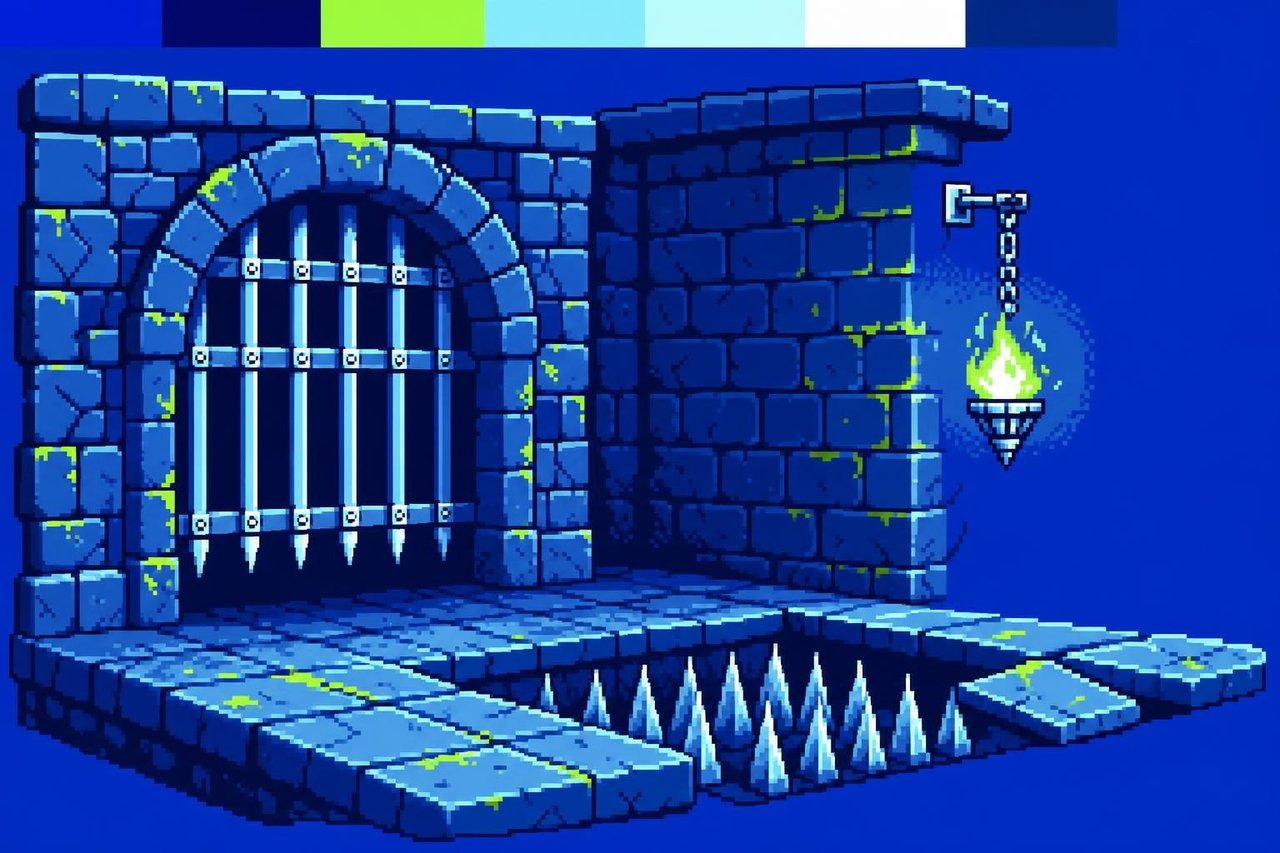
Spike traps kill instantly, as do deep pits (three or more stories) and the guillotine-like blades that snap shut across a passage. Gates open briefly when the hero stands on a trigger, so a typical room asks for pressing a trigger and getting through the opening before it closes. Some gates have locking triggers and hidden traps behind them. Loose floors fall away when stepped on, and false floors or ceilings in some rooms reward a careful look.
The reliable habit is to move carefully when spikes are visible and to look at the next screen before committing to a jump.
Guards, sword fights and the skeleton
The hero finds a sword in the first level, and from there every level adds a swordsman to defeat. Sword moves are advancing, backing off, slashing, parrying and a parry-then-slash combination. A fight is a rhythm of retreat and strike more than a flurry of blows, and guards can also be pushed into traps, which is often the cheaper solution.
In level 3, a skeletal swordsman cannot be killed with the sword. The way past him is to drop him into a pit instead.
Potions and health: where the upgrades are
Red potions restore one unit of health, and blue ones are poisonous and remove one. Large red jars raise the maximum by one, so they are worth the detour whenever the layout shows an unexplored side room. Large green jars give a temporary hover. In level 9 two large green potions flip the screen upside down and then restore it, a small visual joke that also changes how the room reads.
Healing potions are best saved for the moment before a duel, since the small red ones restore only a single unit.
The mirror, the shadow and the middle levels
The middle of the game is where the story shows itself. In level 4, a magic mirror summons the hero’s double, which drains his health to one. In level 5, the double steals a potion. In level 6, it throws the hero into a level 7 dungeon. In level 8, the hero is trapped behind a gate until the princess sends a white mouse to reopen it. These are scripted events, and the player is expected to survive them with whatever health remains.
Walkthrough sources do not agree on every level number for these events, and ports differ, so if a version seems to deviate, trust the one in front of you.
The final levels and Jaffar
The last level asks the hero to merge with his shadow double, since the two share lives. After that he crosses an invisible bridge to reach Jaffar. Jaffar holds the princess in the tower and threatens to force her to marry him or let her die before the hour is up.
The final fight is a long sword duel. Defeating Jaffar breaks his spell and saves the princess, and the timer stops at his death, so the remaining time appears on the high scores. In the DOS and Macintosh ports the final area is stored as level 13, and running out of time there does not end the game once a safe point is reached, though the exact behaviour differs between the two ports.
Versions and where to go next
A prince of persia walkthrough written for the DOS release is the safest baseline, because that version fed many ports. The MS-DOS release of April 1990 became the source for many other ports, including the Amiga, Atari ST, Macintosh, and consoles from NES to Super NES and Sega Genesis. The detailed list is on the page for the 1989 game and its ports. The sequel has its own page, Prince of Persia 2, and the page on ways to play explains how to run either of them today. For the data inside the game, see the DAT file format page.
Frequently asked questions
Can the game be saved?
Saving works in the original only from the second level onward, and not in the middle of a level. The game resumes at the start of the level reached. Because dying restarts the current level without resetting the clock, a save never refunds lost time, so a player aiming for a fast finish should plan routes before moving.
Why does the clock matter so much?
The hour is shared across the whole game. When the hero dies, the level restarts but the timer keeps running, so each failure is paid for in minutes. There is no lives counter.
What do the blue and green potions do?
Blue potions are poisonous and remove a unit of health, so they are best skipped. Large green jars grant a temporary hovering effect. In the ninth level two of these flip the screen upside down and then restore it. Red potions restore one unit, and large red jars raise the maximum by one.
Do console versions play the same way?
Not exactly. The Super NES edition allows 120 minutes and has extra levels, and some other ports have more than twelve. Route advice written for the DOS release can fail on a port, so verify the version before trusting a specific trick.